

From dishes on a tea towel to a dry worktop

After dinner, the dishes that have just been washed stand on a tea towel spread out next to the sink. Water collects under the plates, the towel is soaked within ten minutes, and there is no room left for the chopping board. The next morning, the damp cloth is still lying on the worktop.
In short
In a small kitchen without a dishwasher, the dishes often end up on a towel because there is no fixed place for them to drain. The water then stays on the worktop, and the towel rarely dries properly. A fixed place to drain, where the water runs back into the sink, gives the worktop back its space.
Why does the towel stay on the worktop?
In a small kitchen, every centimetre next to the sink is taken: kettle, chopping board, coffee machine. A dish rack seems to need too much space there, so a towel goes onto the worktop instead. It soaks up water as long as it can, and after that the rest runs out from under the plates.
Then there is the towel itself. The German Federal Institute for Risk Assessment advises keeping separate cloths for hands and for dishes1. Both should be changed at least once a week and washed at 60 °C or more1. A towel that lies wet under the dishes every day quickly falls out of that rhythm. The German consumer advice centres also advise always letting cloths and tea towels dry well after use2.
What clears the worktop again?
The worktop becomes clear as soon as the dishes have their own place to drain and the water no longer stays on the surface. That place does not need to be large. It only has to stand where the water can run into the sink, and it should get smaller on days with only a few dishes.
What does an evening with a dish rack look like?
After washing up, the plates stand upright in a rack next to the sink, with glasses and cutlery beside them. The water runs back into the basin through the drain spout. You wipe the worktop once, and all that is left there is the chopping board for breakfast.
When more guests sit at the table at Christmas, you wash up in two rounds, and the dishes still do not end up on the windowsill.
What helps, with or without a dish rack?
Without buying anything:
- Keep one cloth just for the dishes and hang it up to dry after use.
- Change tea towels and hand towels regularly and wash them hot1.
- Wash up in two rounds: first glasses and plates, dry them and put them away, then pots and pans.
- Clear the space next to the sink so that a fixed draining spot can form there.
- Wash up with a dish brush rather than a sponge. Sponges dry slowly and are rarely replaced2, 3.
With a dish rack:
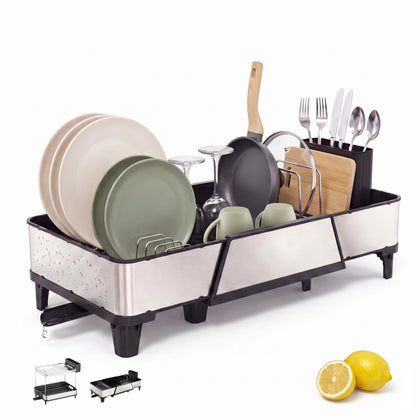
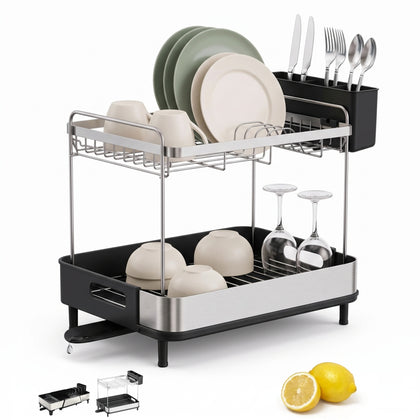
Our shop offers two dish racks made of stainless steel and matte black BPA-free plastic. The Wide-Flex dish rack extends from 42.5 to 63 cm when there are more dishes and slides back together afterwards. Its drain spout fits in three positions. The High-Tower dish rack uses two tiers on a footprint of 42 × 32.2 cm: plates and glasses on top, pots and pans below. Its drain spout turns 360°.
| Wide-Flex | High-Tower | |
|---|---|---|
| Design | extendable, one tier | two tiers |
| Dimensions | 42.5 to 63 cm wide, 32.4 cm deep, 23.5 cm high | 42 cm wide, 32.2 cm deep, 38 cm high |
| Drain spout | fits in three positions | turns 360° |
| Weight | 2.63 kg | 2.85 kg |
| Material | stainless steel and matte black plastic, BPA-free | stainless steel and matte black plastic, BPA-free |
Frequently asked questions
Is it better to dry dishes with a towel or let them drain?
Both work. If you dry with a towel, use a separate one for the dishes and change it and wash it hot regularly1.
How often should I change tea towels?
The German Federal Institute for Risk Assessment names at least once a week and a wash at 60 °C or more1.
How much space does a dish rack need?
The Wide-Flex dish rack is 32.4 cm deep and 42.5 cm wide when pushed together. The High-Tower dish rack stands on 42 × 32.2 cm and is 38 cm high, so measure the height under your wall cabinet.
Where does the water go?
With both dish racks, it runs through the drain spout back into the sink.
What is a dish rack with a drain spout?
A dish rack whose drain spout reaches over the edge of the sink. The water runs straight into the basin instead of collecting on the worktop under the dishes.
Related
Clear floors in small flats: what belongs on the wall
Sources
1. Verbrauchertipps: Lebensmittelhygiene, Reinigung und Desinfektion, Bundesinstitut für Risikobewertung (BfR), https://www.bfr.bund.de/cm/350/verbrauchertipps-zu-lebensmittelhygiene-reinigung-und-desinfektion.pdf, accessed 2 Oct 2026
2. Hygiene in der Küche: Lebensmittel sicher zubereiten, Verbraucherzentralen (verbraucherzentrale.de), https://www.verbraucherzentrale.de/wissen/lebensmittel/lebensmittelproduktion/hygiene-in-der-kueche-lebensmittel-sicher-zubereiten-8338, accessed 10 Nov 2026
3. Fragen und Antworten zum Schutz vor Lebensmittelinfektionen im Privathaushalt, Bundesinstitut für Risikobewertung (BfR), https://www.bfr.bund.de/de/fragen_und_antworten_zum_schutz_vor_lebensmittelinfektionen_im_privathaushalt-193687.html, accessed 10 Nov 2026
You will find more ideas for a calm home at Homellence.
Newsletter
More ideas for your home
New articles, tips and offers by email, straight from Homellence.